architecture / android / ai systems / real-time engineering

Joseph
Annuzzi Jr

Software Architect Android Author AI Systems Builder

I build software where mobile products, advanced AI, blockchain infrastructure, real-time systems, and technical education meet, working from the product question through architecture, implementation, verification, deployment, and iteration.

Kotlin / Compose Claude · Codex · Gemini Python / Solidity / CUDA
PD / SYSTEMS NOTEBOOK / 2006-2026
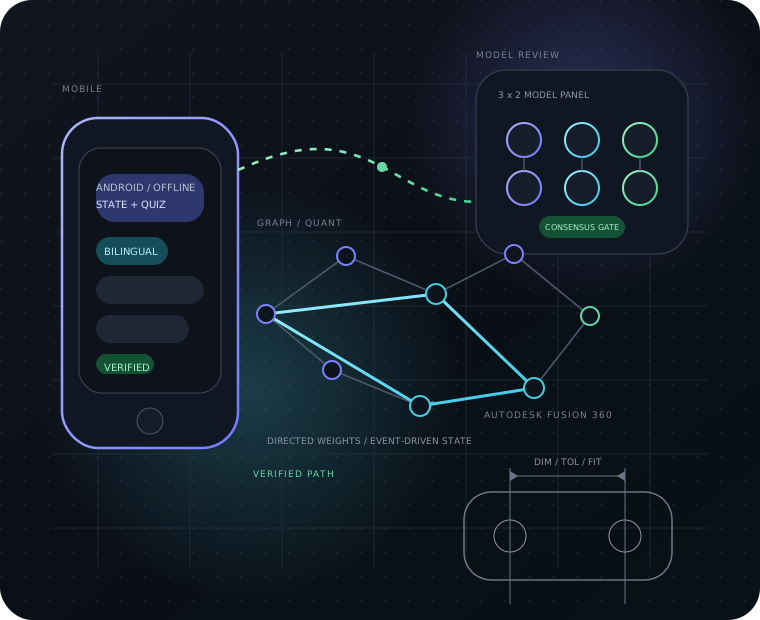
Technical systems lattice connecting mobile geometry, AI review nodes, event streams, graph structures, and CAD dimensions.
systems / verified paths / active research
3major Android editions
7,106bilingual exam questions
58,273grounded learning components
2,559AI-platform automated tests
1,646independent reviewer verdicts
213configured DeFi markets

01 / Selected systems

Engineering work that has to hold together.

Not an exhaustive portfolio. These are a few systems that best show how I work across product definition, architecture, implementation, verification, and deployment.

01.A / ANDROID + VERIFIED DATA

Offline Android learning system

A Kotlin / Jetpack Compose product and verified bilingual data pipeline built from Italy’s official 7,106-question driving-theory bank for English speakers preparing to take the exam in Italian.

7,106translated questions
3,912vocabulary terms
58,273grounded components
23Robolectric tests
  • Translations preserve truth values, numbers, units, thresholds, and terminology while isolating the words and phrases an English speaker must recognize in the Italian exam.
  • A 3,912-term / 4,557-sense vocabulary layer and dual-grounding checks mechanically verify that displayed meanings are supported by each question’s Italian and English text.
  • The offline Android app adds 76 deterministic collision-free quiz batches, SQLite transactions, restart-safe progress, retry flows, and four quiz modes.
KotlinJetpack ComposeSQLiteRobolectricPython
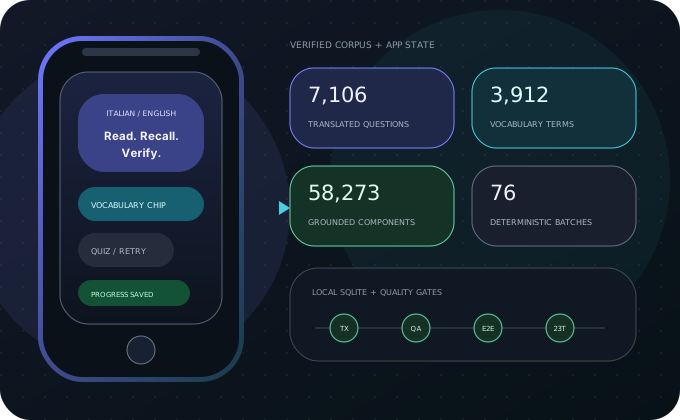
Diagram of an offline Android learning system with deterministic batching, local SQLite state, and test gates.
01.B / MULTI-AGENT DEVELOPMENT + GOVERNANCE

Ralph flywheel: software development from research to certified build

A self-reinforcing multi-agent development system that moves a workload through sourcing, research, specification, planning, implementation, testing, review, and durable institutional memory. Claude Code, OpenAI Codex, and Gemini have separated responsibilities so no model writes and certifies the same artifact.

2,559automated tests
68panel campaigns
1,646seat verdicts
80,466logged MCP calls
  • The staged flywheel runs SEED → SEARCH → RESEARCH → SPEC → PLAN → BUILD; Phase 4 decomposes work into BRIEF → TEST → CODE loops with integration checkpoints.
  • Review, decision, and fix-design panels use a 3×2 matrix with three model vendors in normal and adversarial modes. Fail-closed consensus and REVIEW-AFTER-DECIDE govern architectural choices; the recorded set includes 19 review, 31 decision, and 18 fix-design campaigns.
  • Failures compound into durable constraints: anti-patterns, root-caused pitfalls, issue lineage, and decision records become input to later cycles rather than being forgotten on retry.
  • The governance layer is built and operating; the broader flywheel is being hardened for a real-money prediction-market workload before it is allowed to build and certify that system end to end.
PythonasyncioMCPpytest/HypothesisSQLiteLandlock
Multi-phase software-development flywheel from research through build, wrapped by review, decision, and fix-design governance panels.
01.C / QUANTITATIVE + REAL-TIME SYSTEMS

Prediction-market research backed by real-time on-chain engineering

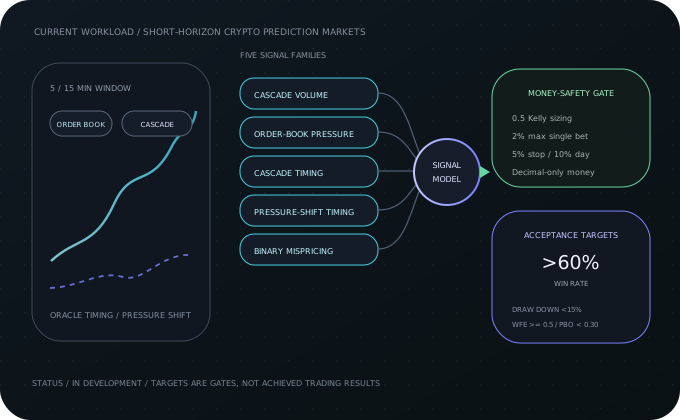
The current quantitative workload is a short-horizon Polymarket prediction system being designed for 5- and 15-minute crypto markets. It combines liquidation-cascade signals, order-book pressure, timing, settlement-oracle behavior, and binary-option mispricing. It is intentionally gated behind the rebuilt flywheel before real money is involved.

5 / 15minute market windows
5signal families
>60%win-rate acceptance target
  • Risk design specifies Decimal-only money arithmetic, half-Kelly sizing, a 2% max single bet, 5% stop-loss, and 10% daily loss limit; acceptance criteria also include drawdown, calibration, walk-forward efficiency, and overfitting limits.
  • The system is designed and specified, not represented as live or profitable. A prior build exposed process weaknesses, which is why the development flywheel and its governance were re-architected before continuing.
  • The workload builds on prior low-latency market and execution research, but its acceptance gates are being redesigned before the flywheel is allowed to drive implementation end to end.

Current status: workload in development; performance figures above are explicit acceptance targets, not achieved trading results.

PythonRust/PyO3Web3.pySolidityWebSocketsCUDA/CuPy
Prediction-market signal pipeline feeding risk and acceptance gates, with prior DeFi graph and on-chain systems as supporting engineering foundations.
01.D / REAL-TIME DEFI + SMART CONTRACTS

Cross-protocol market state, graph search, and atomic execution research

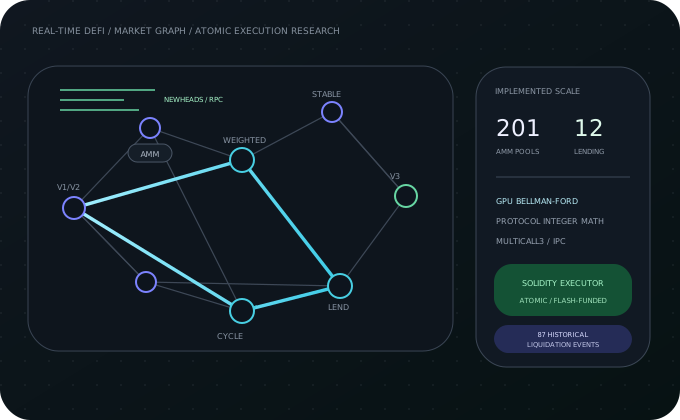
A separate body of implemented real-time DeFi engineering spans heterogeneous AMMs, lending markets, GPU-assisted opportunity search, protocol-specific math, and Solidity execution. It also includes a liquidation system built around pending transactions and historical replay.

201configured AMM pools
12lending markets
6protocol integrations
87historical liquidations
  • An asynchronous WebSocket/HTTP pipeline refreshes current state across 213 configured AMM and lending markets, batching reads with Multicall3 and handling reconnect and fallback paths.
  • Custom CuPy/CUDA Bellman–Ford kernels search directed weighted graphs for negative cycles; candidates are re-evaluated with protocol-specific integer math before execution preparation.
  • An owner-gated Solidity executor supports atomic flash-funded multi-hop routes across six borrow-source and six swap-protocol variants with callback validation, slippage checks, safe approvals, and reentrancy protection.
  • A separate liquidation engine combines lending state, pending DEX/oracle activity, projected collateral ratios, transaction construction, restartable state, and replay/profiling around 87 recorded historical events.

Research and engineering prototypes; no claim of deployed profitability or audited production trading.

PythonasyncioWeb3.pySolidityMulticall3CUDA/CuPy
Directed weighted DeFi market graph connecting AMM and lending venues to GPU search, validation, and Solidity execution.
01.E / PRODUCT + FULL-STACK

Production full-stack web/product engineering

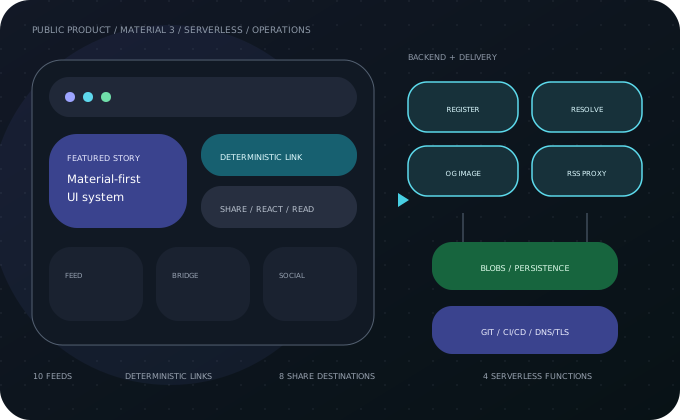
A public Spanish-language content and smart-link product taken from concept to production with a hand-built Material Design interface, deterministic link infrastructure, serverless services, CI/CD, DNS, TLS, and operations.

10content feeds
4serverless functions
8share destinations
  • Responsive, dependency-light frontend with Material Design 3 interaction and component patterns.
  • Deterministic shortlinks, sharing and engagement flows, content normalization, defensive serverless behavior, and persistent storage.
  • Supervised AI-agent workflow with plan-first review, audit-first prompts, and explicit human approval gates.
JavaScriptNode.jsHTML/CSSServerlessDockerGitHub CI/CD
Diagram of a public web product connected to serverless functions, content normalization, CI/CD, and operations.

02 / Published work

Android engineering, taught at book scale.

Three major Android editions as lead and sole active author, plus more than five years of independent technical editing and review.

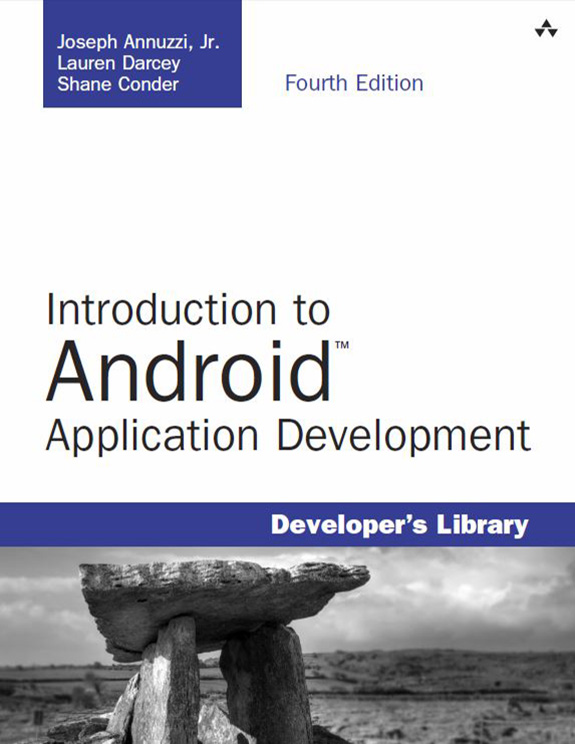
Introduction to Android Application Development: Android Essentials, Fourth Edition cover.
INTRO / 4E / 2013
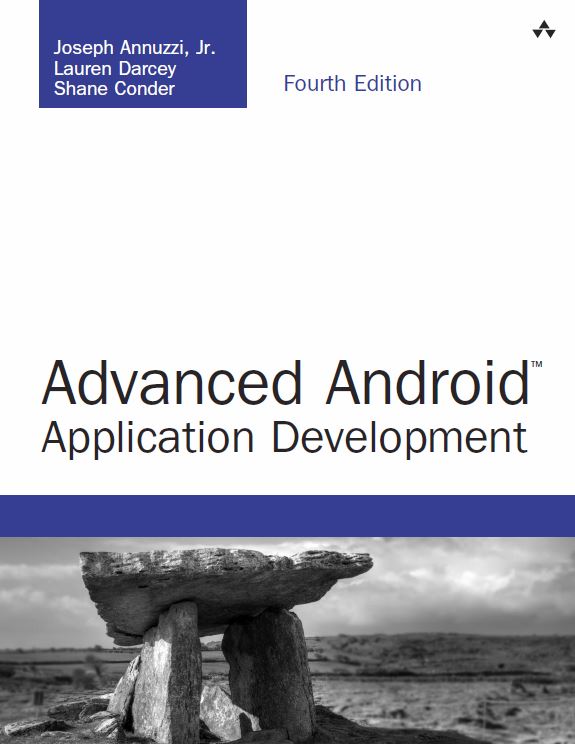
Advanced Android Application Development, Fourth Edition cover.
ADVANCED / 4E / 2014
Introduction to Android Application Development, Fifth Edition cover.
INTRO / 5E / 2015

Each edition combined a major platform migration with substantial original authorship: roughly one-third entirely new material and roughly another third substantially rewritten as Android APIs, SDK tools, build systems, devices, and recommended practices changed.

ECLIPSE / ADT ERA → EARLY ANDROID STUDIO / GRADLE · NEW APIS · NEW SDK TOOLS · NEW CHAPTERS · NEW WORKFLOWS
  • Across all three editions, roughly one-third of the material was entirely new and roughly another third was substantially rewritten. The work went far beyond refreshed screenshots or renamed APIs.
  • Rebuilt inherited Eclipse/ADT-era examples, workflows, screenshots, and development instructions as the Android ecosystem moved toward early Android Studio and Gradle-based builds.
  • Introduced new subject matter for APIs, SDK tools, platform capabilities, device categories, Material Design, permissions, architecture, testing, deployment, and other developments that did not exist in earlier editions.
  • Replanned information architecture and learning sequences, wrote and retested working code and sample applications, rebuilt visual material, created quizzes and hands-on exercises, produced instructor PowerPoint presentations, and carried each edition through technical/editorial review to publication.
TECHNICAL REVIEW / 2008-2013

Reviewed eight additional developer titles across Android, App Engine/Java, CSS3, jQuery, social-platform development, and Rails for technical accuracy, code correctness, completeness, organization, and clarity.

03 / Capabilities

One architecture mindset across very different systems.

The recurring pattern is the same: make the constraints explicit, keep the evidence close to the implementation, and treat the user experience as part of the system, not a layer added later.

01

Android & Mobile

Kotlin, Jetpack Compose, Android SDK, Java, Gradle, SQLite, Robolectric, Material Design, offline-first architecture, mobile UX.

02

AI Systems

Claude Code, OpenAI Codex, Gemini, multi-agent orchestration, staged development flywheels, 3×2 review/decision/fix-design panels, MCP, model verification, persistent state, and agent sandboxing.

03

Blockchain & Smart Contracts

Solidity, Web3.py, EVM tooling, ABI encoding/decoding, AMMs, lending protocols, flash execution, transaction-level systems.

04

Real-Time / Quant Engineering

asyncio, WebSockets, JSON-RPC, event streams, graph algorithms, CUDA/CuPy, protocol math, replay testing, profiling, observability.

05

Technical Content & Developer Education

Information architecture, technical writing/editing, instructional design, working code samples, assessments, documentation systems, content QA.

06

Backend / Full-Stack

Python, Node.js, JavaScript, SQL, REST, serverless systems, CI/CD, Docker, cloud deployment, DNS/TLS, production operations.

07

3D / CAD

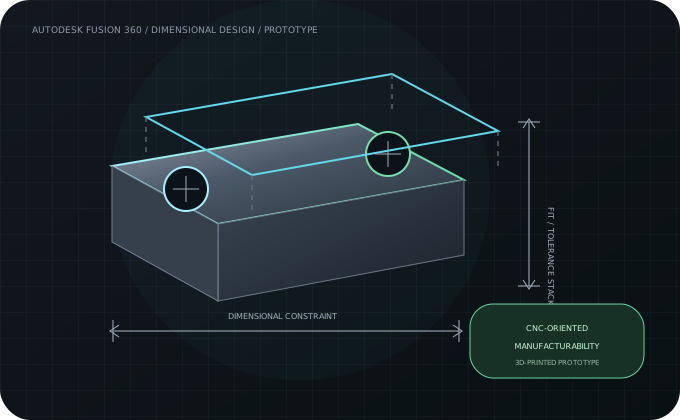
Autodesk Fusion 360, dimensional constraints, tolerances, 3D printing, CNC-oriented manufacturability, plus earlier 2D/3D asset pipelines, WebGL, OpenCV, ffmpeg, and 3ds Max.

CAD-style dimensional drawing with measured geometry and tolerances.

04 / Background

Product questions. Engineering details. The seam between them.

I’m a software architect, Android author, and product builder with a career spanning mobile applications, backend systems, technical publishing, graphics, cloud platforms, blockchain, and advanced AI.

Most of my work has been independent and 0-to-1. PeerDynamic is simply where that work has accumulated over time: products, prototypes, technical research, experiments, and systems that move from an idea into something concrete enough to test.

Recent work has pulled several long-running interests closer together: native Android, frontier-model engineering, real-time blockchain systems, technical content, and the verification machinery needed when software becomes more autonomous.

EDUCATION
University of California, Davis, B.S. Managerial Economics, Minor in Computer Science
PUBLISHED WORK
Lead and sole active author for three major Android editions; technical editor/reviewer for eight additional developer books.
SELECTED CREDENTIAL / TRAINING
ConsenSys Certified Ethereum Developer · Autodesk Fusion 360 and geometric dimensioning & tolerancing training
LinkedIn profile

05 / Connect

A direct line.

For engineering roles, technical publishing, research conversations, or work at the intersection of Android, AI systems, real-time engineering, blockchain, and developer education.

FORM / HTTPS / FORMSPREE / BACKEND VALIDATION

Privacy notice at collection: PeerDynamic collects your name, email address, optional company, message, and related technical submission data to respond to your inquiry, manage a potential professional relationship, and prevent spam or abuse. Formspree processes submissions on PeerDynamic’s behalf. Contact submissions are generally retained for up to 24 months after the last substantive communication. Do not include sensitive information. Privacy details.